
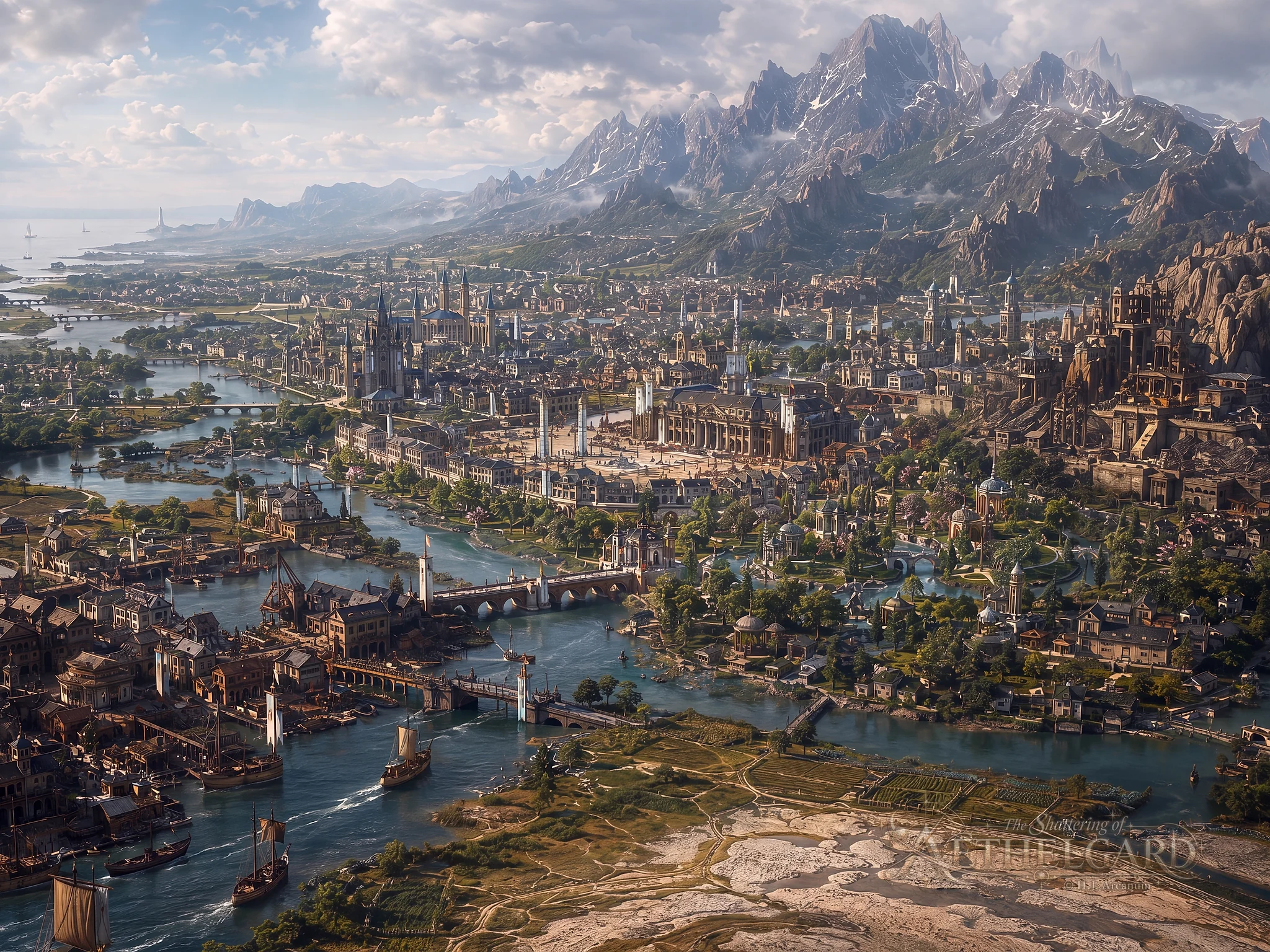
A city after catastrophe
Concordia rose from the long recovery after the First Celestial War. Between Cycle II · Edicts 1601–2000, Humans, Dwarves, Elves and Magicians converged on the great river delta at the western foot of the Whispering Peaks and built a new centre of civilisation.
The Chroniclers offered protection without taking the city as their own government. Concordia instead developed a mortal civic identity shaped by cooperation among the peoples who had survived the earlier catastrophe.
The City of Harmony
At its height, Concordia was known as the City of Harmony. Four major districts reflected its Human, Dwarven, Elven and Magician communities, arranged around a shared civic centre and linked by the waterways, bridges, ports and trade routes of the delta.
Its Council of Four Voices represented those communities in a system of co-governance. The arrangement was never perfect, but it gave Concordia a powerful identity as a deliberate attempt to build cooperation after the failures and devastation of the previous age.
A fragile balance
Concordia’s prosperity could not remove every division within the city. Over time its political balance weakened, outside power became more intrusive and disagreements within its institutions made the old model of harmony increasingly difficult to sustain.
By the city’s final centuries, the institutions that had once balanced its four communities no longer carried the same authority, leaving Concordia increasingly vulnerable as the wider world moved toward war.
The fall of Concordia
When the Second Celestial War—Ragnarok, the War of All Species—swept across Aethelgard, Concordia was no longer able to present the united defence it once might have offered. The city was breached and sacked during the final phase of the conflict.
By Cycle II · Edict 3350, Concordia had ceased to exist as a functioning city. Its districts and civic centre were reduced to ruins, ending the civilisation that had defined the delta for centuries.
From Concordia to Havenstone
Around Edict 3355, survivors returned to the devastated river delta during the Silent Years. Rather than reconstruct Concordia exactly as it had been, they chose to build a new city on the site: Havenstone.
That succession gives Concordia an unusual place in Aethelgard’s history. Its geography remained strategically important, but its political identity did not simply survive the war. Havenstone became a new answer to the same question of how different peoples could live and govern together after catastrophe.
A civilisation seen before the fall
The World Explorer shows Concordia at Cycle II · Edict 3200, before its destruction, and Havenstone in the present era on the same river-delta site. Together, the two views reveal how one city gave way to another across the centuries.